Scoop.it

Opinion | “Finfluencers” ou la finance sous influence

Ils s’appellent Alessio Rastani, Robert Breedlove, Dan de Chartguys ou encore Krown’s crypto cave. Ils sévissent sur YouTube, Twitter, Instagram ou encore Tiktok. Ces "finfluenceurs" vous accompagnent dans la gestion de vos finances personnelles et, parfois même, dans votre initiation à l’investissement sur les marchés financiers. Ils ont généralement une spécialité : l’analyse technique, le marché actions ou encore les crypto-actifs. Leur audience ne fait que grandir. Démocratisation et accessibilité Le dernier sondage Audirep pour la Banque de France, en date de juillet 2020, a souligné un paradoxe : les Français sont une majorité (52 %) à s’intéresser à l’actualité et aux sujets financiers, mais ils sont pénalisés par des lacunes importantes dans leur éducation financière. Dit autrement, ils ne maîtrisent pas les connaissances financières de base.  L’essor des finfluenceurs est donc a priori une bonne nouvelle. Ils contribuent à démocratiser les questions de finance personnelle et rendent accessible les sujets plus complexes, comme la blockchain et les crypto-actifs. Alors que les grands établissements financiers peinent à s’adresser aux 18-35 ans, les finfluenceurs ont réussi à capter leur attention en proposant un contenu parfaitement adapté – souvent court, toujours dynamique et généralement dénué de jargon financier – et en utilisant les canaux d’information auxquels ils ont le plus recours à savoir les réseaux sociaux. Aux États-Unis, 41 % de ceux appartenant à la Génération Z (ceux nés après 1995) ont déclaré avoir eu recours à Tiktok pour accéder à de l’information financière au cours du mois de décembre 2020, selon une étude publiée par Lending Tree en janvier 2021. Les jeunes plébiscitent les réseaux sociaux, car ils en maîtrisent les codes, et y trouvent des interlocuteurs qui savent s’adresser à eux simplement et sans jugement. Grandeur et décadence Les finfluenceurs sont souvent talentueux, parfois sans avoir eu d’expérience préalable en finance. Beaucoup sont des autodidactes. Ils savent également très bien monétiser leur audience. Mais tous ne sont pas fiables. Certains ne mettent pas en garde contre les risques inhérents aux investissements financiers. On pensera par exemple aux risques liés à l’effet de levier qui permet d’investir plus que ce qu’on a réellement en bourse, mais qui peut aussi entrainer des pertes massives en cas de retournement de marché.

By |2021-08-04T09:59:37+00:00August 4th, 2021|Scoop.it|0 Comments

Usbek & Rica – « Métavers » – Quand Zuckerberg rêve d’un monde 100 % Facebook

Cette « nouvelle réalité » correspondra-t-elle au futur de l’humanité ? Depuis l’émergence de ce concept dans les années 1990 (l’auteur Neal Stephenson avait été le premier à l’imaginer dans son roman Le Samouraï virtuel, sorti en 1992), certains y croient en tout cas dur comme fer. Comme nous vous le racontions au début de l’année dans cet article, dans les années 2000, le succès du monde virtuel de Second Life avait relancé l’idée d’un univers numérique parallèle au nôtre. La hype pour ce jeu avait cependant fini par s’évanouir au fil des années et, au tournant des années 2010, l’émergence des réseaux sociaux avait achevé de parasiter une bonne partie des imaginaires numériques les plus fous portés par l’humanité. Stories, scroll infini, notes vocales… L’avenir de la tech se résumait, ces dernières années, à ces « mises à jour ». À l’aube des années 2020, d’aucuns pensent donc qu’il est temps de relancer la machine à fantasmes. Ainsi de Tim Sweeney, le créateur du célèbre jeu Fortnite, qui avait, début 2020, permis au rappeur Travis Scott de donner un concert en exclusivité sur ce qu’il convient désormais d’appeler une plateforme à part entière, où l’on peut « rejoindre nos amis » comme on les rejoindrait dans un bar ou dans la rue. Sans compter la sortie imminente de Facebook Horizon, un projet de réseau social en réalité virtuelle porté par les équipes de Mark Zuckerberg, toujours en phase de test mais sur lequel l’entreprise semble très fortement miser. Confirmation justement apportée par le principal intéressé en cette fin juillet 2021 dans le cadre d’une interview accordée au média américain The Verge : du statut de « réseau social », le PDG de Facebook veut faire passer son entreprise à celui de « métavers ».

By |2021-08-02T12:51:43+00:00August 2nd, 2021|Scoop.it|0 Comments

Hôtellerie : Apple intègrera bientôt les clés de chambre numérique

Voilà une nouvelle qui devrait simplifier la vie des éditeurs d’applications hôtelières et les hôteliers eux-mêmes. A l’automne, la version définitive d’iOS sera disponible pour les détenteurs d’iPhone. Dans cette nouvelle version du logiciel, l’application Wallet va évoluer : en alliant la technologie NFC (sans contact) à ce range documents numériques, les clients d’un hôtel pourront désormais y embarquer leur clé d’hôtel dans sa version numérique. Plus besoin pour eux de télécharger nécessairement une application pour y avoir accès. L’iPhone peut être verrouillé ou même éteint sans que cela n’entrave le processus. Si la version bêta d’iOS 15 est d’ores et déjà disponible, sa version définitive le sera à l’automne prochain.

By |2021-07-29T22:23:13+00:00July 29th, 2021|Scoop.it|0 Comments

A la découverte de téléphones « made in Rdc », dotés d’une technologie exclusive | CIO MAG

Okapi est une marque de téléphones créée par Jean Bele, chercheur en physique nucléaire à l’Université américaine Massachussetts Institute of Technologie (MIT). Cette marque propose des tablettes, kits oreillettes, chargeurs solaires et téléphones intelligents grâce à l’utilisation d’une technologie exclusive. (Cio mag) – Créée en 2019 par Jean Bele, chercheur en Physique nucléaire à l’Université américaine Massachussetts Institute of Technologie (MIT), la marque Okapi veut changer la donne du marché de la téléphonie mobile en République Démocratique du Congo. « Okapi est une marque nationale pour la République Démocratique du Congo qui fera la fierté de l’Afrique et développera davantage les capacités du continent en matière de production et de technologie. Elle vise également à créer de l’emploi en RDC », peut-on lire sur son portail. Des fonctionnalités uniques Okapi utilise une technologie exclusive et unique qui permet de fournir des fonctionnalités sur ses Smartphones au niveau de la résistance à la poussière, à l’eau, la reconnaissance faciale et la détection d’empreintes digitales. En 2019 après sa création, les téléphones de cette marque ont été commercialisés à Kinshasa, la capitale de la RDC et aux Etats-Unis pour « garantir ses performances et recueillir ainsi les commentaires des utilisateurs ». Une année plus tard, elle a présenté une série de téléphones intelligents de première génération, dont, les Smartphones, les tablettes, les kits oreillettes et les chargeurs solaires. Inspirée par Okapi, cet animal qu’on ne peut retrouver qu’en République Démocratique du Congo, cette marque est gérée par Ujengo Lab LLC, un incubateur et centre de développement des solutions technologiques. Ainsi, après ses premiers pas plutôt réussis sur le marché de la téléphonie mobile en République démocratique du Congo, cette marque projette améliorer son support et explorer les opportunités pour développer les capacités d’assemblage et de fabrication.

By |2021-07-29T21:34:08+00:00July 29th, 2021|Scoop.it|0 Comments

Nigéria : le eNaira annoncé pour octobre 2021 | CIO MAG

La Banque centrale du Nigéria (CBN) annonce pour le 1er octobre 2021, la phase pilote de la monnaie électronique du Nigéria, le eNaira, qu’elle émet. (CIO Mag) – Après moult tractations et pourparlers, le géant ouest-africain est prêt à lancer sa propre monnaie électronique. Elle sera la version numérique du Naira et permettra d’induire l’inclusion financière dans le pays. Ainsi, le eNaira va simplifier les paiements, faciliter le commerce transfrontalier, réduire les coûts des paiements internationaux et sécuriser les transactions. Lire aussi «« Nigéria : un projet de monnaie électronique en gestation Rappelons qu’en février dernier, la première puissance économique d’Afrique interdisait à ses banques et institutions financières de traiter ou de faciliter les transactions en crypto-monnaies à destination et en provenance de l’Afrique. Après quoi, le Directeur des technologies de l’information de la Banque centrale du Nigéria, Rakiya Mohammed, avait annoncé la naissance avant fin 2021, d’un projet de monnaie numérique. Ce qui vient d’être fait. Lire aussi «« Nigeria : cryptomonnaies interdites au secteur bancaire « uniquement » (Banque centrale) Le Nigéria s’arrime ainsi à la tendance internationale selon laquelle les Etats du monde commencent à émettre leur propre monnaie électronique. En Afrique, le Maroc, l’Afrique du Sud et l’Egypte l’ont déjà fait. C’est désormais au tour du Ghana d’y penser.

By |2021-07-29T21:32:17+00:00July 29th, 2021|Scoop.it|0 Comments

81 Countries Are Now Exploring Central Bank Digital Currencies — 5 CBDCs Fully Launched – Regulation

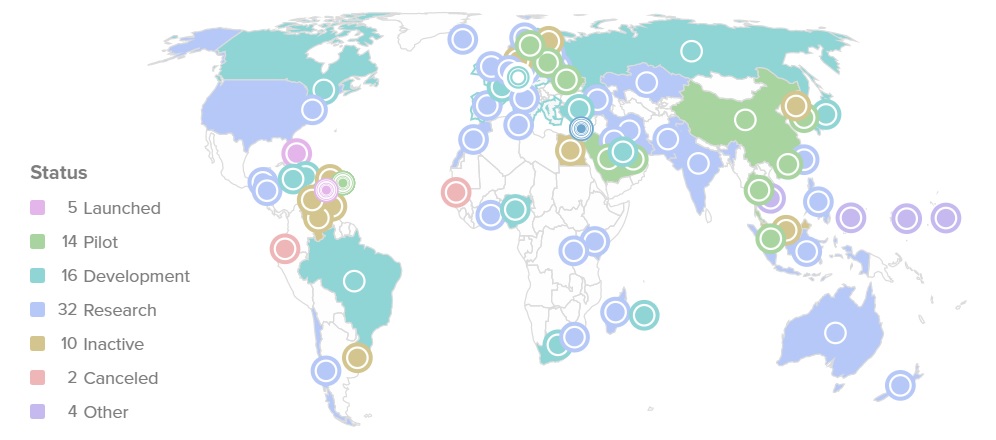
81 Central Banks Explore Launching Own Digital Currencies The Atlantic Council’s Geoeconomics Center unveiled a new central bank digital currency (CBDC) tracker featuring an interactive database last week. The Geoeconomics Center described itself as “a nonpartisan organization that galvanizes U.S. leadership and engagement in the world, in partnership with allies and partners, to shape solutions to global challenges,” its website states. The original version of the CBDC tracker, launched in April last year, has been used by the U.S. Federal Reserve and the Bank of International Settlements (BIS), the center claims, adding that according to the new tracker: 81 countries (representing over 90 percent of global GDP) are now exploring a CBDC. In our original report published in May 2020, only 35 countries were considering a CBDC. The center noted that “Of the countries with the 4 largest central banks (the U.S. Federal Reserve, the European Central Bank, the Bank of Japan, and the Bank of England), the United States is furthest behind” in developing a state-backed digital currency. Federal Reserve Chairman Jerome Powell said in February that the digital dollar was a “very high priority” for the Fed. However, he emphasized the need to “get it right,” instead of rushing to launch a digital dollar, particularly to compete with China’s digital yuan. Nonetheless, the chairman recently said, “you wouldn’t need stablecoins, you wouldn’t need cryptocurrencies if you had a digital U.S. currency. I think that’s one of the stronger arguments in its favor.” Meanwhile, “5 countries have now fully launched a digital currency,” the Geoeconomics Center added. They are the Bahamas, Saint Kitts and Nevis, Antigua and Barbuda, Saint Lucia, and Grenada.

By |2021-07-25T16:18:13+00:00July 25th, 2021|Scoop.it|0 Comments

Le groupe hôtelier Pavilions Hotels & Resorts accepte la crypto monnaie

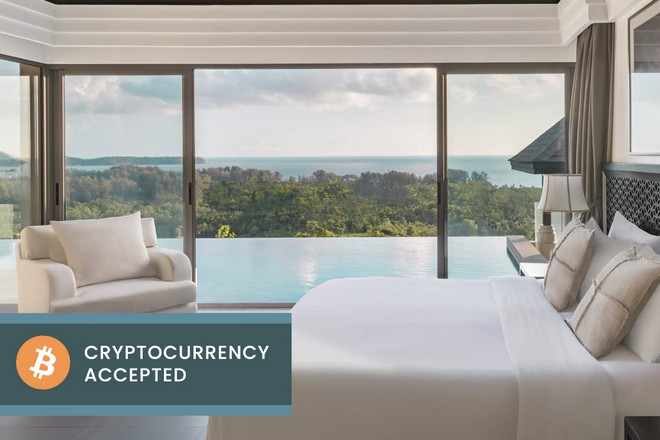
Le groupe hôtelier international The Pavilions Hotels & Resorts annonce qu’il accepte la crypto monnaie pour les réservations. Le groupe est associé à la passerelle mondiale de crypto-paiement, Coindirect, permettant aux clients de payer avec Bitcoin, Ethereum et 40 autres devises virtuelles, 24 heures sur 24 et 7 jours sur 7. Des hôtels en Asie et en Europe Les paiements par crypto-monnaie sont disponibles pour les réservations directes via chaque centre de réservation d’hôtel à partir du 7 juillet 2021. Prochainement, il sera également disponible sur les moteurs de réservation de sites Web.  Le groupe dont le siège est situé à Hong-Kong possède des hôtels en Asie (Bali, Phuket, Mongolie, Niseko,…) et en Europe (Rome, Madrid, Amsterdam). « Les expériences personnalisées sont au cœur de notre ADN » présente Gordon Oldham, fondateur et propriétaire de The Pavilions Hotels & Resorts. « Permettre cette flexibilité dans les paiements combinée à la sécurité et à la tranquillité d’esprit de nos clients est la prochaine étape des services personnalisés et sur mesure » dit-il. Les Pavilions Residences, qui sont disponibles à la vente dans les complexes de Phuket et Niseko du groupe, accepteront également les crypto-monnaies pour la vente de propriétés.

By |2021-07-25T13:33:31+00:00July 25th, 2021|Scoop.it|0 Comments

Renault mobilise les médias sociaux pour son offre de services Mobilize

Renault mise sur les réseaux sociaux pour l’expansion de Mobilize, sa marque de services de mobilité. La marque Mobilize s’exprimera sur trois plateformes sociales Twitter, Instagram et LinkedIn. Rassembler tous les acteurs de la mobilité, de la data et de l’énergie La stratégie sociale vise à rassembler tous les acteurs de la mobilité, de la data et de l’énergie de demain. Les réseaux sociaux seront un hub d’expérimentation et d’innovation à part entière. Ils seront un espace où Mobilize veut catalyser les conversations sur le futur de la mobilité. Mobilize se dote de la signature sociale #WeAreMobilizers. Les premiers pans de cette nouvelle stratégie sont présentés depuis juin. L’expression sociale a été utilisée à l’occasion du salon VivaTech, du 16 au 19 juin 2021, auquel participait Mobilize. Un live sur le média social vidéo Twitch et une centaine de contenus ont été déployés, générant 4 millions de reach sur les trois premiers jours.  Mobilize a fait partie du Top 10 des marques les plus citées et retweetées à VivaTech. Le social media est l’outil de communication retenu pour encourager les nouveaux usages, et pour bâtir les services de demain avec l’ensemble des cibles et de l’écosystème de Mobilize.

By |2021-07-25T13:32:58+00:00July 25th, 2021|Scoop.it|0 Comments

Jeff Bezos Goes to Space. Day Three: Reentry | WIRED

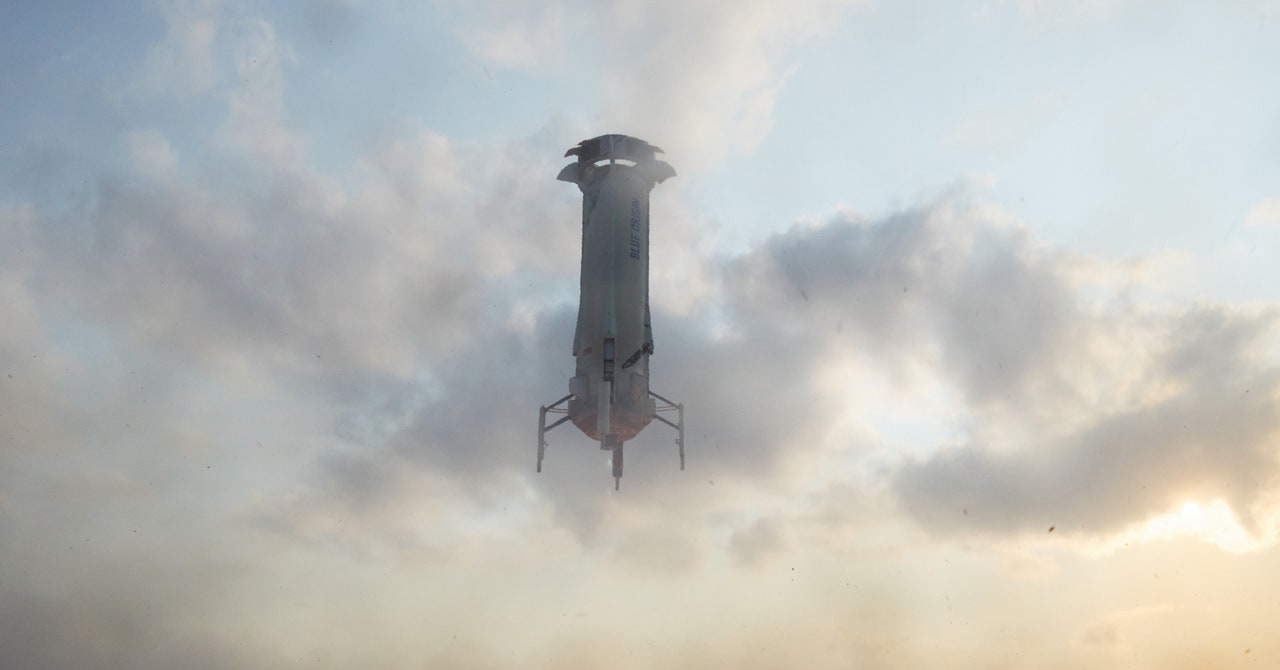
This month has been all about how viewing the Earth from space—even the dicey definition of “space” from a barely-there demarcation of either 50 or 60 miles—will change your life, make you realize that we’re all in this together, and put you face-to-face with God, without a Covid mask. That was readily apparent when Bezos and his three crewmates on Blue Origin’s New Shepard suborbital rocket returned from their 10-minute journey. All four agreed that space was an awesome, life-changing experience. In his first broadcast interview, Bezos first said that it was so overwhelming that he didn’t have the verbal skills to express it—maybe only a poet could do that. Later, in a postflight press conference, he attempted it. “OH MY GOD!” was his first reply to the question on how it felt. Then he got very quiet and tried to describe a feeling where, almost like the end of Kubrick’s 2001, space had taken him to a primal restoration of the human state. “It felt so normal, even as if humans were evolved to be in that environment, which I know isn’t possible, but it felt so serene, and peaceful.” And sure, Bezos cares deeply about the environment—he’s put $10 billion into a climate fund—but he really didn’t get how fragile the Earth was until he peered down on it from above the Kármán line. “The most profound thing for me was looking at the Earth, and looking at the Earth’s atmosphere,” he said. “When we’re driving around in our cars, the atmosphere is so gigantic, and we’re tiny things, and the atmosphere is so big. But when you get above it, you see it’s incredibly thin! It’s this tiny little fragile thing. It’s one thing to recognize it intellectually; it’s another thing to see it.” This came on the heels of similarly dreamy exclamations by another space billionaire, Richard Branson, who also portrayed his own self-financed suborbital jaunt as something beyond human language. “I’m never going to be able to do justice to it,” he said at his own press conference. “It’s indescribably beautiful.” A word he kept using was “inspiration”—space, in his view, was not an infinite void but a life-changing mountaintop that symbolizes what humans could accomplish. Even Virgin’s lead operations engineer, Colin Bennett, who was on the flight, hopped onto the awe train, depicting space as kind of a heaven. “It’s very zen,” he said. “It’s very peaceful up there as well. What jumped out at me were the colors and how far away it looked … I was just mesmerized.” Space travel, it seems, is all about inspiration, beauty, and returning … to our natural state? Of course, we’ve already heard plenty about the intangible magic of gazing down at Earth from NASA astronauts who happened to experience spiritual moments in the course of their work. But as people increasingly visit space not to work, but to indulge in a life-changing experience, revelation moves from a serendipitous side effect to the point of the matter. The premise of space tourism isn’t exactly guaranteed satori, but it’s certainly implied. (That, and a lot of fun floating around. Video from RSS First Step, the capsule of New Shepard, showed the crew tumbling and playing, tossing a ball, and pitching gravity-free Skittles at each other.) But even as Jeff Bezos was gushing about the amazeball-ness of his flirtation with space, the fact is that ultimately, all of that mumbo jumbo is secondary to him. The thrills and revelations of space travel are but enablers of the main reason he started Blue Origin: to begin a journey on which millions of human beings would leave the Earth to live and reproduce in space colonies, extending our species to over a trillion souls. He was explicit about it when I spoke to him in 2018: “I like the adventure of space; that's great,” he said. “But that pales in comparison to the importance of making sure that our grandchildren's grandchildren don't face a life of stasis. Basically, we have a choice to make as a civilization, which is, Do we expand into the solar system or do we accept stasis here on Earth? There have been many reasons over the years that people have given for why we need to go to space, and this is the only one that I personally find super motivating.” Yesterday at his postflight press conference, he repeated the message, though tactically avoided explicit talk of space colonies. “What we are doing is not only adventure,” he said. “It’s also important. Because what we are doing is something big … We’re going to build a road to space so that our kids—and their kids—can build a future.” He went on to insist that his goal wasn’t escaping Earth, but saving it, as it’s “the only good planet in the solar system.” But as I understood him from hours of conversation in 2018, he sees Earth as a preserve, a haven, that can be conserved once destructive manufacturing is moved to the unimaginable vastness of space, so the natural ecology can prosper. People still living here will be Earth’s caretakers. The huge population of humans living in lush galactic colonies—think not of the cramped International Space Station, but massive verdant structures with lakes, shopping malls, and stadiums—can return to their home planet for visits or residencies. This is the dream Bezos has nurtured since high school, when he idolized futurist Gerald O’Neill, who popularized the space colony vision, and the future Blue Origin founder even devoted his own high school graduation speech to the subject. Space tourism, as he said yesterday, is a small step toward that. His goal is to catalyze a mighty industry of space businesses. While his competitive juices lead him to compete with Virgin Galactic and especially SpaceX, his rival for government contracts, he’s rooting for them because he believes that an infrastructure for space ventures will advance that very long-term dream, which he believes is inevitable if civilization is to prosper. Seen in that light, Bezos’ emphasis on enlightenment was business. If you are going to charge people hundreds of thousands of dollars for a suborbital ride, it helps to be offering more than an adult bounce house. Bezos says Blue Origin has already lined up $100 million in passenger commitments, will do two more flights this year, and hopes to step up the cadence. Practice in launching and reusing rockets and settling into a routine flight schedule will help Blue Origin, and others, bring down the price, concoct innovations, and eventually develop that space infrastructure Bezos wants. Once it’s built, entrepreneurs will be able to enter the field with much less capital. We’ll have bustling business in all sorts of new satellite technologies, and, as the action shifts beyond orbiting to the moon and planets, off-Earth manufacturing will become possible. At least, according to the Bezos, that’s the dream. And that’s why I feel that, even though the achievement of suborbital space was pretty much accomplished and shelved in 1961, the flight of New Shepard in the Texas desert this week was worth our close attention. “This is going to take decades—this is a big vision,” Bezos said yesterday. “Big things start small, and this is how it starts.” I’m not quite sure that I buy into his arguments that so much of humanity has to live off the planet to thrive. And I’m bothered that, right now, private space travel is the plaything of billionaires. But the world’s richest man and one of the smartest, a man who has built one of the world’s biggest businesses, is seriously pursuing what would literally be a world-changing process. That’s a hell of a story.

By |2021-07-25T09:04:16+00:00July 25th, 2021|Scoop.it|0 Comments

Crypto Experts Predict Bitcoin Price Rising to $318,417 by December 2025 – Markets and Prices

A panel of crypto experts has predicted that the price of bitcoin will rise to $318,417 by December 2025. The most bullish expert believes that the price of the cryptocurrency will reach $160,000 by the end of the year. Meanwhile, 54% of them think that hyperbitcoinization will happen by 2050. Crypto Experts Share Bitcoin Price Prediction Finder, a major product comparison website, has conducted a study to find out the future outlook of bitcoin as its popularity grows. “As awareness of cryptocurrencies continues to spread, all eyes are on bitcoin’s price. So we asked our panel of 42 cryptocurrency experts what’s in store for the coin,” the company detailed last week. The panelists include crypto asset managers, executives of crypto exchanges and other service providers, crypto analysts, professors, and lecturers at universities. Among various topics discussed was what the price of bitcoin will be at the end of the year and a few years from now. Finder detailed: While there may be some medium term price depreciation, the panel predicts that by December 2025, the price of BTC will go up to $318,417. The company added, “This is 61% higher than the panel’s end-of-2025 prediction in December 2020, but 12% lower than that in April.” Furthermore, the “Panelists predict that by December 2030, the price of bitcoin will go up to a whopping $4,287,591 per BTC. However, the average is skewed by outliers – when we look at the median price prediction, the 2030 price forecast comes down to $470,000,” Finder wrote. As for what the price of bitcoin will be at the end of the year, the majority of panelists (61%) said bitcoin is currently undervalued and on average the panel expected the price of the cryptocurrency at the end of 2021 to reach $66,284 per coin. Morpher CEO Martin Fröhler was the most bullish about the price of bitcoin on the panel. With a year-end prediction of $160,000 per BTC, he opined: Adoption by corporations and institutional investors paired with a loose monetary policy and high asset inflation will propel bitcoin to 6 figures before the end of this year. The next halving cycle will see increased adoption of bitcoin as a legal tender by developing countries, and until 2030, bitcoin will have replaced gold as a global reserve asset. Wave Financial senior trader Justin Chuh gave a lower-than-average price prediction of $56,000 for the year end. Nonetheless, he expressed confidence in bitcoin as the “tried-and-true safe haven” of digital assets. The trader sees the price of bitcoin on an upward trend, predicting that BTC will end 2025 at $210,000 and 2030 at $400,000, with halving events and inflation pushing the price upward. He said: Halving events and inflation along the way to 2025 and 2030 will likely trigger the larger upside moves. Prices are likely to be continuously driven by supply and demand, less availability for a wider group of users. However, not everyone on the panel was as bullish. University of Canberra’s senior lecturer, John Hawkins, was among the most bearish on the panel. His year-end prediction was $20,000 per bitcoin. The lecturer also believes that countries adopting bitcoin will actually have a negative impact on its price.

By |2021-07-24T16:04:00+00:00July 24th, 2021|Scoop.it|0 Comments